

What does your Monday morning look like? Rushed footsteps. A steaming cup of black coffee. Piled-up work waiting to be addressed, and glass walls. The kind of walls that promise stability, a fixed salary, and the quiet reassurance of dignity in work. Inside, the air conditioner hums softly at an optimum temperature. Outside, the city is already awake. As we complain about the traffic on our way to the office or rush between meetings, it is easy to forget that life beyond these glass walls unfolds very differently. Stepping outside them for a moment, the landscape changes. There are people whose labour happens under the open sky, whose work carries neither the comfort of climate control nor the certainty of a monthly paycheck. This series of blogs, Beyond the Glass Walls, is an attempt to pause and look outward. To listen more closely. To bring into focus the voices and experiences that often remain unheard, and to tell stories of resilience that unfold far from the comfort of our offices.
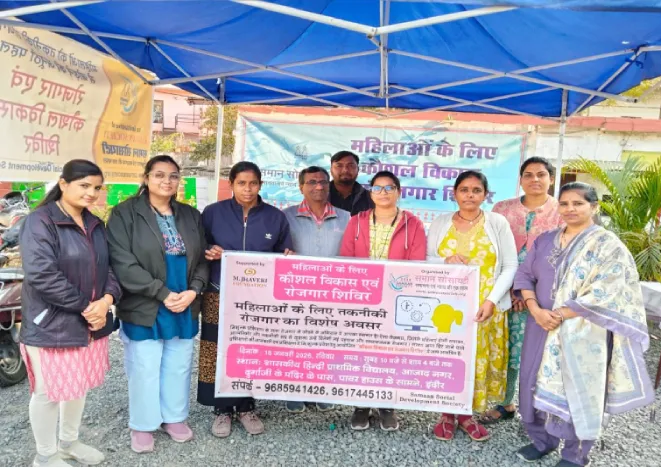
At Samaan Development Society in Indore, one can witness stories spun by a group of women who dared. Dared to challenge everything that was told to them. Dared to question structures. Dared to step out of their comfort zones and carve out a liminal identity for themselves. Dared to dare. My encounter with them happened by chance, on a distressing Tuesday morning in Indore, as my scooty came to a halt in the middle of a narrow lane. Standing confused and losing any shred of hope of reaching the office on time, I was told by a passerby that there was a mechanic’s garage nearby. Heaving a sigh of relief, I dragged my scooty some five hundred metres away from where it had given up on me. When I finally reached the garage, I briefly wondered if I had come to the wrong place. Instead of the familiar sight of men bent over engines, I was greeted by the warm smile of Shivani di, who runs the garage alongside a group of women mechanics. I had not set out to learn a lesson about gender and the division of labour that morning, but there I was, quietly amused by how a few women had chosen to dare and reshape their realities.
Since time immemorial, there has been a deep-rooted division between the care economy and the machine economy. Women make up only 0.03% of India’s transportation workforce, revealing how firmly mechanical and transport-related occupations remain gendered. For many women riders, the problem is not simply reaching the road but navigating spaces built around male expertise. The question then becomes not just who drives, but who holds the knowledge and control that make mobility possible. In Indore, Samaan Social Development Society intervenes precisely at this intersection. Through its women mechanics initiative, the organisation creates a subtle but powerful trickle-down model of empowerment, where women from modest socio-economic backgrounds gain technical skills that allow them to move beyond narrowly defined gender roles.
The policy structures that shape work
Over the past decade, the Indian state has begun to acknowledge the rapid transformation of labour markets, particularly with the expansion of informal and platform-based work. One of the most significant legal shifts in this direction came with the Code on Social Security (2020), which for the first time formally recognised gig workers and platform workers as distinct categories within labour law. Complementing this framework, the government has also attempted to create a national database of informal workers through the e-Shram portal, which enables registration of unorganised workers, including gig and platform workers, to facilitate access to welfare schemes and skill development initiatives. While frameworks increasingly encourage women’s economic participation, they rarely address the deeper barriers that prevent women from entering male-dominated technical occupations. It is precisely within this policy gap that initiatives like Samaan Society’s mechanic training programme acquire significance, expanding the possibilities of what women’s work can look like.
Women who chose otherwise
As the initial surprise settled, the rhythm of the garage slowly began to reveal itself. Tools clinked against metal, scooters rolled in and out, and customers stopped to ask questions with the same casual familiarity one would expect at any neighbourhood repair shop. At the centre of this small but busy space stood Shivani Raghuvanshi. Shivani is twenty-seven now, and she has spent the last seven years working as a mechanic. Her entry into this world was not ignited by a childhood fascination with machines, but by necessity. Growing up in a household where her father’s alcoholism made income unpredictable, Shivani learned early that stability would have to be built rather than expected. When Samaan Society started its training camps, she decided to attend, walking nearly ten kilometres each day to reach the sessions. Today, Shivani helps run a garage collectively managed by women. The confidence with which she speaks to customers, picks up tools, and directs work inside the shop reflects years of experience. There is also something disarming about her presence; her jovial, welcoming face makes the garage feel less intimidating than most.
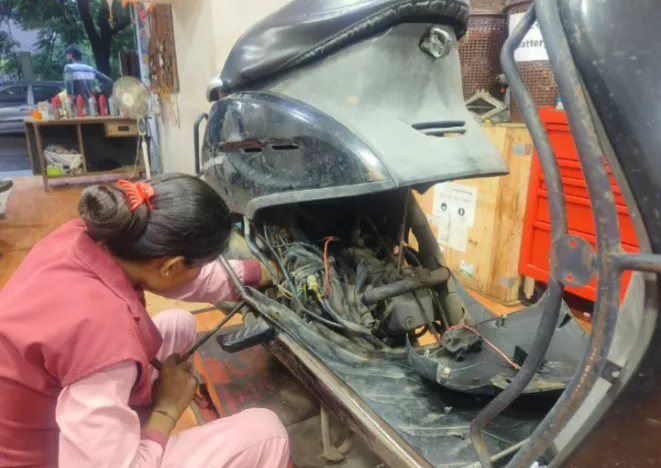
Durga can be seen busy sorting spare parts a few steps away, slower but deliberate in her movements. At forty-eight, she entered this profession after the sudden loss of her husband forced her into the role of sole provider in the family. The shift was abrupt and practical rather than ideological. With two sons to raise, work could not wait for social acceptance. Her days stretch between the garage and the household, where meals must still be cooked, and routines maintained. The double burden is real, but so is the quiet satisfaction she draws from her work. She speaks with particular warmth about her sons, who have grown openly proud of what she does. Laughing, she remembers how they once brought their friends’ motorcycles to the garage, insisting that their mother would fix them properly. That moment carries a meaningful victory for Durga, who balances both motherhood and an unorthodox profession as a woman on a daily basis.
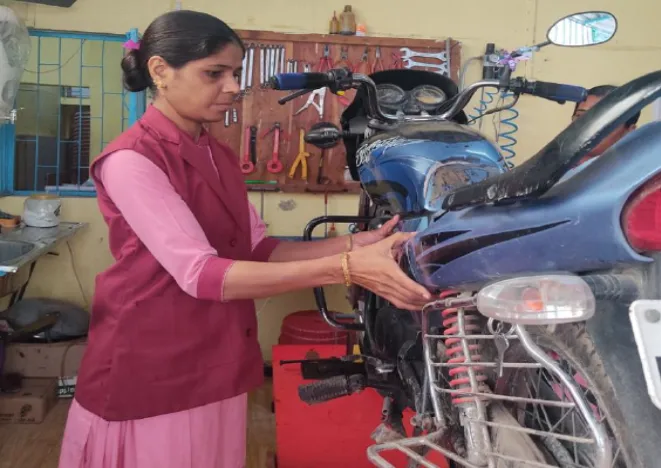
Reshma belongs to a different stage of the journey. At twenty-three, she spends part of her day at the garage and the rest attending classes for her Bachelor of Business Administration degree from Kothari College, Indore. Where Shivani speaks in the language of experience and Durga in the language of responsibility, Reshma speaks in the language of possibility. She is particularly drawn to the accounting side of the work, often keeping track of expenses and small transactions while learning the mechanics alongside. Her goal is not necessarily to remain in the garage forever but to move towards a more formal sector job, one that offers stability and recognition. The aspiration is striking precisely because it does not demean the garage-work; instead, it treats this space as a stepping stone toward a different future.
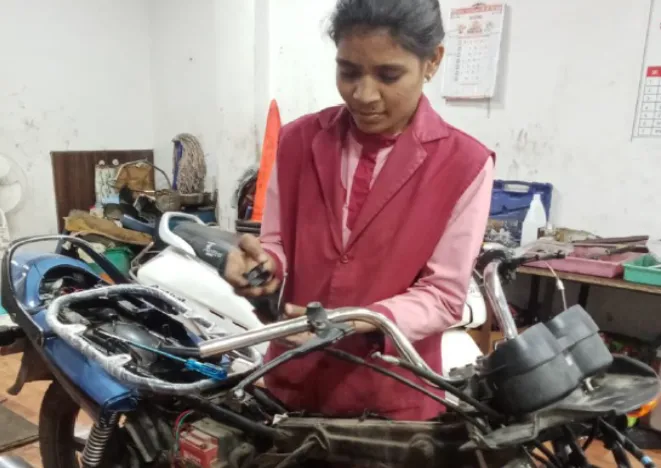
Together, these three trajectories form a continuous picture of resilience and success. Shivani represents endurance, Durga represents responsibility, and Reshma represents aspiration. Their paths intersect in a workplace that challenges inherited boundaries without pretending that those boundaries have disappeared. In their hands, the tools of repair become something more than instruments of livelihood. They become small but persistent claims to a share of the road.
What their stories tell us
The stories from this garage offer a glimpse of what becomes possible when opportunity meets determination. They suggest that the boundaries between gendered distribution of labour are far less fixed than they appear. Yet these stories remain the exception rather than the norm. In the Indian society, only a small number of women find access to professions that offer both economic security and public visibility. For many others, work continues to unfold within the narrow lanes of the informal economy, where employment is uncertain with limited social protection and mobility is shaped as much by social permission as by physical access. At the same time, there is a quiet optimism in what Samaan Development Society has made possible. These women show that gendered divisions of labour are less about ability and more about opportunity. If the road has long been mapped in ways that exclude women, their work redraws its lines.
One repaired engine at a time.
Author: Nilasri Bhattacharya
Sources:
- Samaan Society, Yantrika Women Mechanic Programme: https://samaansociety.org/indias-first-women-mechanic-garage/
- Public Transportation and Gender (India Brief): https://www.briefindia.com/public-transportation-and-gender/
- Gender Gap in Mobility in Urban India (Research Paper): https://arxiv.org/abs/2208.08990
- Women Drivers in Tier 2 Cities: https://kogta.in/blog/women-drivers-in-tier-2-and-tier-3-cities-driving-growth-and-opportunities/
- Employment News, Women in Gig Economy: https://employmentnews.gov.in/newemp/MoreContentNew.aspx?k=90333&n=InDepthJobs
- NITI Aayog Policy Brief, Gig Economy: https://www.niti.gov.in/sites/default/files/2023-06/Policy_Brief_India%27s_Booming_Gig_and_Platform_Economy_27062022.pdf
- ORF, Gender and Gig Economy: https://www.orfonline.org/research/gender-and-the-gig-economy-a-qualitative-study-of-gig-platforms-for-women-workers-65948
- ISB Research, Women’s Inclusion in Gig Economy: https://www.isb.edu/faculty-and-research/srini-raju-centre-for-it-and-the-networked-economy/womens-inclusion-in-the-gig-economy-an-unfulfilled-promise
- Women and Work in India, Data for India: https://www.dataforindia.com/women-and-work/