

The Whisper
It started with a whisper over dinner.
“Do you know,” a fellow donor murmured, “that the report that said 140 children were in class overstated reality, but only about 15 ever appeared on school rolls?”
I froze. I had read the NGO’s annual report many times. It had polished pictures, neat infographics, numbers that made everything look promising. But that whisper lodged itself in my mind like grit under glass. Was the story too carefully written? Or was I, like many others, beginning to lose faith in the very act of giving?
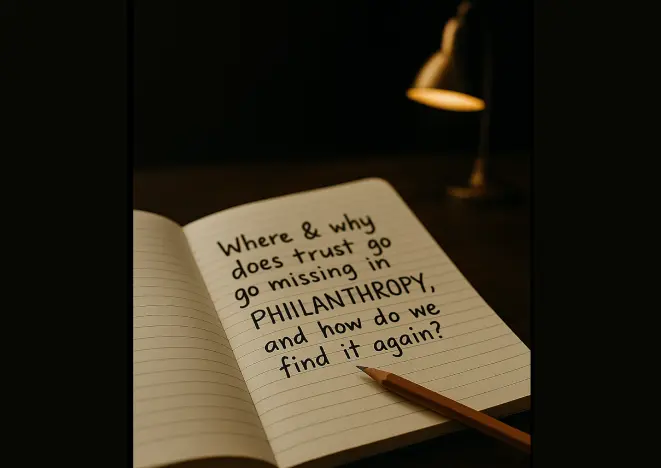
That night, I opened my notebook and wrote one question at the top of a blank page:
Where & Why does trust go missing in philanthropy, and how do we find it again?
The Landscape
The next morning, I began to dig deeper..
Philanthropy in India isn’t a side-stage story anymore. It’s a vast, rapidly evolving ecosystem. Private giving reached roughly ₹1.2 lakh crore (~US$15 billion) in FY 2023, a 10% year-on-year jump1. Nearly half of this comes from family philanthropy, led by a small but influential group of ultra-high-net-worth individuals (UHNWIs) and family offices2. In fact, just the top 100 donors accounted for over 75% of total private philanthropic capital in 2023; a level of concentration rarely seen in mature markets3.
Individual giving from affluent citizens and smaller donors is also rising steadily contributing 25–30% of total private philanthropy. Much of this growth has been fuelled by digital giving platforms like GiveIndia, Milaap, and Ketto, which have lowered the barrier to entry for individual donors. This has created a two-speed landscape: a concentrated pool of very large gives from HNIs and family foundations, and a widening long tail of smaller, often one-off contributions.4
The large foundations like Azim Premji Philanthropic Initiatives, Tata Trust, Infosys, Nilekani philanthropy, and others have staff, monitoring systems, evaluation teams, and brand recognition that help them publish reports and attract further support. Smaller grassroots organisations operate without full-time fundraising teams, monitoring officers, or any sort of communications capacity; they often cannot sustain frequent audits or glossy impact reports. The result is an informational asymmetry: the visible organizations are often able to build reputational capital, while quieter, potentially high-impact ones, working at an absolute grassroot level, struggle for attention and reach.5
That imbalance with visibility and capacity on one side, thin resources and limited disclosure on the other, is the seam where trust often frays. It is also where donors’ verification demands collide with NGOs’ capacity constraints, setting the stage for the deeper investigation to follow.
The Trust Deficit
By the third week of my exploration, the pattern was undeniable.
Every donor I spoke to wanted accountability. Every NGO I met pleaded for understanding. One NGO head in Chhattisgarh sighed, “We spend more time proving our honesty than doing on-ground work which is our real forte.”
This tug-of-war had a name: the trust deficit. On one side were donors demanding impact dashboards, financial audits, and ROI-style accountability. On the other, NGOs struggled to meet those demands without the budget to hire accountants, data analysts, or communications staff.6 7
The more the sector tried to measure impact, the more it risked losing its soul. A 2022 survey by Dasra and Bain of 230 NGOs found that 56% of small and mid-sized NGOs reported stress and resource strain due to donor reporting demands, while 41% admitted to inflating numbers in at least one report to satisfy donor expectations 8 . Similarly, a study by Kearney revealed that 72% of NGOs experienced funding deficits, with many citing insufficient donor support for overhead costs as a significant challenge.9
The consequence was striking. A generalised mistrust was hurting both donors and organisations. Donors, unsure whom to trust and doubtful if the real story on-ground was invisible behind polished reports and dashboards, gravitated toward large, well-known foundations with strong monitoring systems. Smaller organisations, despite delivering meaningful impact, remained invisible or viewed sceptically. Unequal access to information led people to trust the visible few, of-course doing great work as well, but pushing the less-visible ones to the side-lines10 .
The tension was clear: donors demanded certainty; While many NGOs demonstrated strong local impact, and expanding those results at scale remained a persistent challenge. And yet, both sides were motivated by the same goal of effective, meaningful giving. How could that gap be bridged? The answer, I would soon discover, lay in transparency that goes beyond spreadsheets.
What Transparency Really Does
By the fourth week, I had witnessed enough to grasp the deeper stakes. Transparency is not merely a rhetorical flourish; for small NGOs, it is a lifeline. Without transparency, no mater what the impact they create, these organisations remain invisible to donors, trapped in a self-reinforcing cycle of under-funding. Yet, embracing transparency is not simply publishing annual reports or checking compliance boxes.
Scholarly literature demonstrates that transparency enhances legitimacy and reduces information asymmetries between NGOs and their stakeholders, especially donors. Transparent reporting of financials, program outcomes, and governance mechanisms strengthens donor trust, thereby facilitating sustained engagement. However, as Burger (2010) observes, transparency is effective only when coupled with institutional capacity and internal accountability systems.11
In India, this relationship between transparency and donor behaviour is particularly salient. The “Pay-What-It-Takes” (PWIT) model, introduced by The Bridgespan Group, advocates that funders should finance the true cost of non-profit operations, including indirect expenses such as administrative staff, technology, and infrastructure, rather than restricting funds to direct programmatic costs. Despite 75 % of funders claiming to support organisational capacity, approximately 70 % of Indian NGOs report a mismatch between these claims and the actual funding received.12 This discrepancy mirrors what has been termed the non-profit starvation cycle, wherein organisations underinvest in essential systems due to donor aversion to overheads.13
Furthermore, Kearney and Dasra’s India Nonprofit Report 2025 revealed that 72 % of NGOs experienced funding deficits, with many identifying the lack of donor support for overhead costs as a significant constraint.14 This finding underscores that financial transparency alone is insufficient if donors fail to recognise the importance of operational sustainability. Without adequate investment in capacity, transparency risks becoming a double-edged sword, exposing inefficiencies without equipping NGOs with the resources to address them.
Smaller NGOs, in particular, face challenges in developing robust monitoring and evaluation (M&E) frameworks, financial management systems, and skilled personnel. As a result, transparency initiatives can inadvertently amplify organisational weaknesses. Evidence from India indicates that indirect costs across NGOs range from 5 % to 51 % of total expenditure, yet donors commonly allocate less than 10 % for these needs.15 Such patterns reveal that transparency must be integrated with capacity building rather than treated as an isolated compliance exercise.
The real challenge, therefore, lies in balancing transparency with capacity. Donors must be willing to invest in institutional development like strengthening governance, technology systems, staff training, and learning frameworks and not merely in short-term programs. Bridgespan’s 2021 analysis outlines four pivotal actions: forming multi-year partnerships, closing the indirect-cost funding gap, investing in organisational development, and building financial reserves for resilience.16 I realised when transparency is accompanied by such sustained investment, it can achieve its true purpose of building trust, enhancing credibility, and enabling meaningful long-term social impact.
In essence, transparency must be understood as a structural condition, not a performative one. Without donor commitment to the Pay-What-It-Takes ethos and the institutional empowerment of NGOs, transparency risks devolving into a bureaucratic exercise. When genuinely resourced, however, it becomes a transformative instrument for accountability, legitimacy, and sustainable development.
The Global File
By the fifth week, my field notes extended beyond India’s borders. The transformation toward transparency, I realised, was not simply regional; it was reconstituting philanthropy on a global scale.
Across the international philanthropic ecosystem, major foundations have begun to institutionalise openness as a core operational principle. The Ford Foundation’s 2015 policy requiring all grant-funded research and data to be published under Creative Commons (CC BY) licensing marked a critical step toward knowledge democratisation, converting privately funded intellectual outputs into public goods 17. Similarly, the Hewlett Foundation and the MacArthur Foundation have made transparency intrinsic to their evaluative frameworks, publishing not only impact assessments but also instances of strategic missteps and lessons learned. 18, 19 Scholars describe this shift as radical transparency: a practice that transforms vulnerability into institutional strength by framing disclosure as an epistemic commitment to learning rather than a reputational risk. 20
In India, this evolving global ethos has found institutional form through the Social Stock Exchange (SSE), created under the Securities and Exchange Board of India (SEBI). The SSE is designed to embed transparency within philanthropic and social finance systems by mandating disclosures on governance, audited financials, and verified social impact indicators. 21 Academic analyses interpret the SSE as part of a broader philanthropic financialisation process, structuring social value creation through regulated disclosure norms and investor confidence mechanisms. 22 Though still emergent, it represents a paradigm shift from voluntary reporting to standardized accountability within Indian philanthropy.
At the same time, organisations like Let It Count within India have been crucial in operationalising transparency from within the sector. By curating verified organisational profiles, financial data verifications, and sectoral insights, they have created an ecosystem in which openness is both expected and rewarded. 23, 24 Their work demonstrates how data-driven philanthropy enhances trust, reduces information asymmetries, and professionalizes the giving landscape. As scholars such as Pharoah and Keidan (2020) note, transparency intermediaries act as “trust architects,” creating infrastructures that enable more equitable and evidence-based philanthropy.25
Transparency, then, is evolving from a moral aspiration into a structural expectation. Philanthropy, once characterised by anonymity and discretion, increasingly mirrors financial systems in its demand for traceability and accountability.
The Culture Shift
The longer I observed, the more I realized that transparency is less about tools and more about temperament. Some NGOs practiced what I came to call “radical transparency.” They shared their raw learnings: failures, course corrections, even disagreements with donors. One rural education nonprofit in Bihar published its internal memos online, explaining why a literacy program hadn’t met its goals. Instead of backlash, it received new partnerships and empathy.
This was a different kind of giving: philanthropy as partnership, not transaction. Many next-generation donors now seek this openness. They want to co-design programs, attend review meetings, and experience accountability first-hand. In turn, NGOs that adopt transparency not as compliance but as culture are building the most resilient relationships.
As the Stanford Social Innovation Review notes, “trust-based philanthropy begins where performance reporting ends.”26 Transparency here isn’t about numbers. It is about narrative honesty. It is saying, “This is where your money went. This is what worked. This is what didn’t. And this is what we learned.”
Closing the Case
Weeks after that initial whisper, I revisited the NGO that had built only half the classrooms. I didn’t go as a critic, I went as a learner.
The truth, it turned out, was complexity. Rising brick costs, delayed permissions, and a cyclone had halted construction. But none of that was in the report. The NGO had feared that admitting setbacks might jeopardize future funding.
As we walked through the half-built site, one child tugged my sleeve and said, “We come every day, and we love being here”
That moment closed the exploration for me. The problem wasn’t dishonesty, it was silence. The fear of losing trust had become the very reason for losing it.
Endnotes
- Bain & Company & Dasra. India Philanthropy Report 2024. Total private philanthropy ₹1.2 lakh crore; 10% YoY growth; retail giving 25–30%; family philanthropy 35–40%; digital platforms contribution https://www.bain.com/insights/india-philanthropy-report-2024/ .
- EdelGive Hurun India Philanthropy List 2022. Top philanthropists (Premji, Ambani, Nadar, Tata, Nilekani); concentration of giving. https://indiacsr.in/edelgive-hurun-india-philanthropy-list-2022-released/ .
- Bain & Company press release (2023). Growth projections, top 100 donors contributing >75% of total capital. https://www.bain.com/about/media-center/press-releases/2023/private-philanthropic-giving-in-india-to-reach-1.86-lakh-cr-in-fy-2027-expected-to-grow-at-11/
- Bain & Company & Dasra. India Philanthropy Report 2024.
- Ibid
- Ibid
- Dasra & Bain (2022). Survey of 230 NGOs: 56% reported stress from donor reporting; 41% admitted inflating numbers. https://www.dasra.org/resources/publication/dasra-philanthropy-survey-2022
- Kearney & Dasra. India Nonprofit Report 2025. 72% of NGOs experienced funding deficits; challenges in securing donor support for overhead costs. https://www.kearney.com/industry/public-sector/article/india-nonprofit-report
- Edelman Trust Barometer 2023. Decline in trust towards NGOs; low-income individuals are less trusting than their wealthier counterparts. https://www.edelman.com/trust/2023-trust-barometer
- Dasra & Bain (2022)
- Burger, R., & Owens, T. (2010). Promoting Transparency in the NGO Sector: Examining the Determinants of Disclosure for NGOs in Developing Countries. World Development, 38(9), 1263–1277. ScienceDirect
- The Bridgespan Group. (2021). Pay-What-It-Takes Philanthropy in India: Bridging the Gap on Funding True Costs of NGOs. Bridgespan Report
- Gregory, A. G., & Howard, D. (2009). The Nonprofit Starvation Cycle. Stanford Social Innovation Review, 7(4), 49–53. SSIR
- Kearney & Dasra. (2025). India Nonprofit Report 2025. Public Sector & Social Impact Division. Kearney
- Garg, S., & Venkat, R. (2021). How to Overhaul Grantmaking in India. Stanford Social Innovation Review. SSIR
- The Bridgespan Group. (2021). Building Strong, Resilient NGOs in India. Bridgespan Report
Ford Foundation. (2015). Ford Foundation - Expands Creative Commons Licensing for All Grant-Funded Projects. Creative Commons News Release.
- William and Flora Hewlett Foundation. (2021). Learning and Evaluation Transparency Policy. Hewlett Foundation.
- MacArthur Foundation. (2021). Learning, Transparency, and Accountability. MacArthur Foundation Reports.
- Reich, R. (2018). Just Giving: Why Philanthropy Is Failing Democracy and How It Can Do Better. Princeton University Press.
- SEBI. (2024). Framework for Social Stock Exchange in India. Securities and Exchange Board of India.
- Sadhwani, A., & Kadaba, A. (2024). Transparency and Financialisation in Philanthropic Markets: An Analysis of India’s Social Stock Exchange. Journal of Development Policy and Practice, 9(2), 145–168.
- Dasra. (2025). India Philanthropy Report 2025. Dasra & Bain & Company.
- GuideStar India. (2024). Transparency Key and Seal Programme: Annual Report 2024. GuideStar India.
- Pharoah, C., & Keidan, C. (2020). Transparency and Trust in Global Philanthropy: The Role of Data Intermediaries. Journal of Philanthropy and Marketing, 25(3), e1712.
- Stanford Social Innovation Review. (2020). “Trust-Based Philanthropy Begins Where Performance Reporting Ends.” SSIR Essay Series on Philanthropic Practice.
Author: Shruti Patil