

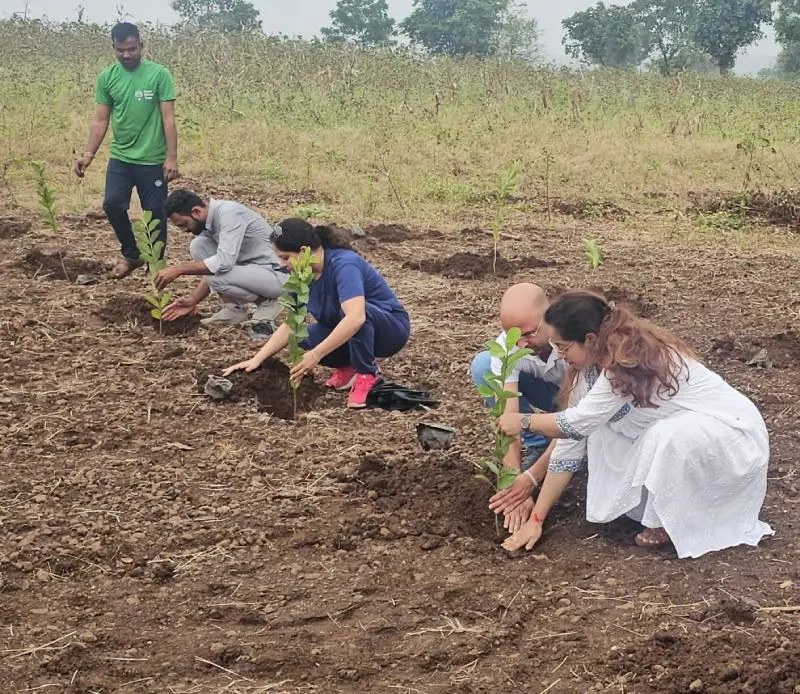
The planet is losing its forests at an alarming pace. Of the estimated six trillion trees that once covered the Earth, barely three trillion remain today. Every year, deforestation contributes to seven million premature deaths caused by air pollution and drives an 83% decline in global wildlife populations due to habitat loss. The effects are no longer distant warnings—rising temperatures, erratic rainfall, and intensifying weather events are already threatening food and water security across communities worldwide.
Our partner organisation is addressing this crisis through community-led agroforestry, integrating native and fruit-bearing trees with mixed cropping systems across rural India. This approach regenerates degraded land while increasing farmer income and resilience. Each plantation is geo-mapped and digitally monitored, supported by a three-year stewardship program that ensures survival through technical guidance, periodic follow-ups, and transparent impact tracking.
The results are visible—fields once barren are transforming into thriving green belts that capture carbon, restore biodiversity, and cool microclimates. Farmers are witnessing improved soil health and sustainable livelihoods, while citizens everywhere can take part in reforestation that actually endures.
By combining technology, transparency, and community ownership, this initiative is converting individual action into collective impact—rebuilding ecosystems, empowering rural families, and nurturing a greener, more resilient planet for generations to come.
Sources:
- Crowther, T. W., et al. (2015). “Mapping tree density at a global scale.” Nature, 525(7568), 201-205.
- World Health Organization. (2023). Ambient (outdoor) air pollution Fact sheet
- WWF. (2022). Living Planet Report 2022 – Building a nature-positive society. Almond, R.E.A., Grooten, M., Juffe Bignoli, D. & Petersen, T. (Eds). WWF, Gland, Switzerland.